
Mobility as Metabolism: From Urban Bicycles to Proximity Systems
Urban Climate Series Part 4 of 4
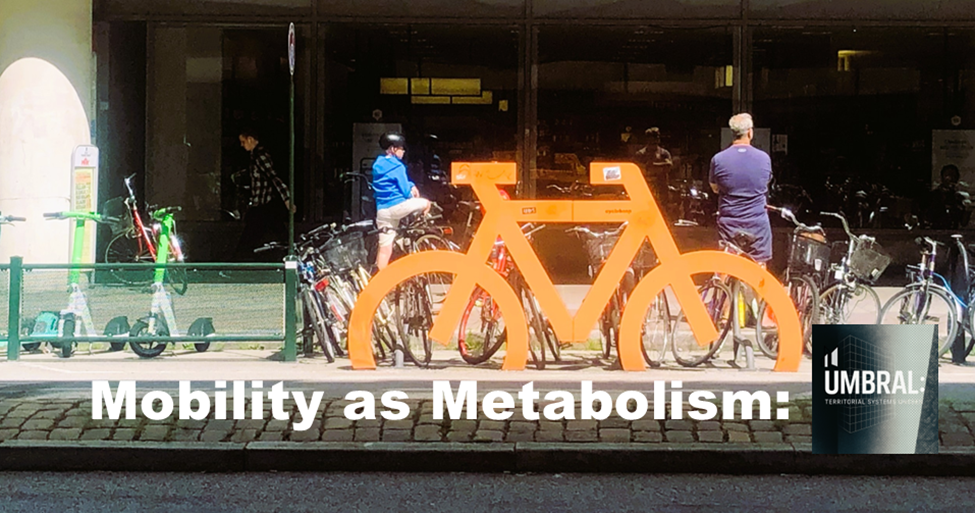
After a few months of pause —necessary to reorganize agendas, projects, and perspectives- I return with this fourth and final piece of the series on Malmö and Copenhagen.
The previous publications explored different layers of urban metabolism: the relationship between water and resilience, the social and ecological role of green spaces, and the potential of permeable surfaces as active infrastructure. This final chapter focuses on the theme that connects them all: mobility, its energetic, cultural, and symbolic dimensions. From the bicycle as a metabolic unit to the notion of proximity as a planning principle, and the experimental Flowerly Proximity application, this closing reflection explores how movement itself can become a way to re-dimension the city.
Malmö and Copenhagen: The Bicycle as Metabolic Infrastructure
In Malmö and Copenhagen, the bicycle is more than a means of transport: it is a metabolic unit connecting energy, space, and time. Its natural speed—between 10 and 20 km/h—matches the human body’s rhythm and defines a territorial measure compatible with ecological scale. In these Nordic models, the cycling network functions as metabolic infrastructure, transforming muscular energy into clean mobility and closing the loop between health, climate, and sociability. The real success lies not in the physical infrastructure but in building a culture of slow movement, a collective pedagogy that links mobility with wellbeing, responsibility, and belonging.
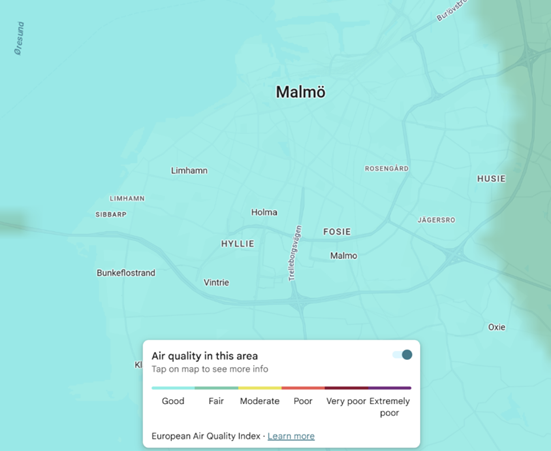
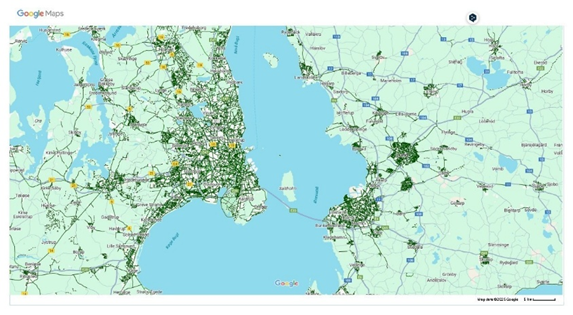
Urban metabolism is not defined solely by infrastructure but by the relationship between energy, health, and mobility. In Malmö, air quality data reflects the effectiveness of a mobility model that balances wellbeing and sustainability. Clean air is not a coincidence: it is the outcome of a system that recognizes the bicycle as primary metabolic infrastructure, not as an accessory. The cycling network linking Malmö and Copenhagen, visible in the territorial map, illustrates how two cities have woven their metabolism around active mobility. The territory becomes permeable and continuous, shaped by human flows rather than administrative borders. These northern models reveal a metabolic maturity that southern European regions are only beginning to explore. Yet within that difference lies an opportunity: internal and post-demographic territories can build their own versions of proximity. The aim is not to replicate Nordic models but to learn from their energetic and cultural coherence, reinterpreting mobility as a form of knowledge. Movement ceases to be an act of transit and becomes an act of reading. Perhaps the future is not about moving less, but about moving with more meaning.
The “Città di Prossimità”: The Territory Measured by the Body
I have been awarded a study grant to attend the Short Master in “La città di prossimità come prospettiva di sviluppo urbano” at the Politecnico di Bari, starting in January 2026. The program invites reflection on the city as a system of proximity, where the human body once again becomes the unit of territorial measurement. This approach seeks to reduce the urban metabolic perimeter, limiting unnecessary travel and reinforcing local self-sufficiency. Neighbourhood micro-centralities, services, green areas, facilities allow for the reorganization of territorial energy without expanding its footprint. Rather than accepting uncritically the rhetoric of the “15-minute city,” the challenge is to ask how that notion can evolve into an applied methodology for observation, design, and planning, where proximity is not reduction but a concentration of meaning and quality.
At this point, I have more questions than statements: what happens when urban systems no longer allow spatial reorganization to concentrate quality of life and belonging?
Flowerly Proximity App: Mobility, Perception, and Symbolic Data
Flowers of Proximity originated as a participatory research method developed within European projects on proximity planning, including Accessibility Planning for the 15-Minute City (Acc<15’) and UNIQUE – Universal Design Strategies for the Proximity City. These initiatives aimed to understand how people perceive accessibility, equity, and quality of life in their everyday environments, using the metaphor of a “flower” to represent the temporal and emotional distances that shape urban life.Based on these methodological results, the research team later developed an interactive digital tool (app) that visualizes users’ responses as a flower, where each petal represents a domain of daily life—work, education, health, leisure, relationships, or services—and the perceived time or distance to reach it.
I conducted this test in Albano di Lucania, a mountain territory in Basilicata, part of Italy’s aree interne. These areas face a critical condition: ongoing depopulation, loss of local services, and strong dependence on private cars. Most work and everyday activities require traveling to the regional capital, while public transport (buses) is scarce or irregular.
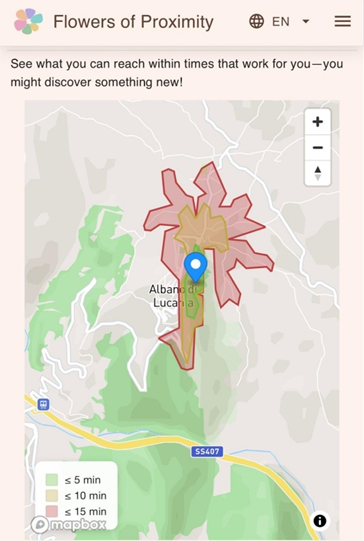
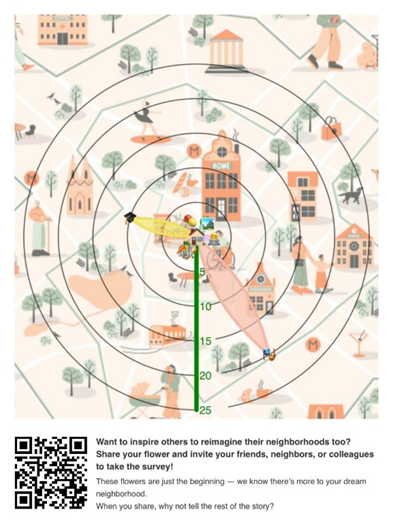
The resulting flower reflects these realities: its petals are elongated and asymmetric, revealing a radial mobility pattern oriented toward a single direction—the city. The central area, where petals overlap, exposes the fragility of local proximity services: few, scattered, and often more than 10–15 minutes away even for basic needs. This morphology shows that in post-demographic territories, proximity is not a spatial condition but a cultural and energetic construction. The flower reveals not only transport limitations but also the patterns of social relations, repetitive paths, and the tension between isolation and dependence.
In my view, Flowers of Proximity can evolve into a sensitive diagnostic and design tool, capable of making the invisible visible: inequalities of access, fragmented social ties, and the erosion of quality of life across Mediterranean hinterlands.
𝗜 𝗶𝗻𝘃𝗶𝘁𝗲 𝗿𝗲𝗮𝗱𝗲𝗿𝘀 𝘁𝗼 𝗰𝗿𝗲𝗮𝘁𝗲 𝘁𝗵𝗲𝗶𝗿 𝗼𝘄𝗻 𝗳𝗹𝗼𝘄𝗲𝗿, 𝘁𝗼 𝗼𝗯𝘀𝗲𝗿𝘃𝗲 𝗵𝗼𝘄 𝘁𝗵𝗲𝗶𝗿 𝗱𝗮𝗶𝗹𝘆 𝗺𝗼𝗯𝗶𝗹𝗶𝘁𝘆 𝗶𝘀 𝗱𝗿𝗮𝘄𝗻, 𝗮𝗻𝗱 𝘁𝗼 𝗿𝗲𝗳𝗹𝗲𝗰𝘁 𝗼𝗻 𝗵𝗼𝘄 𝗰𝗹𝗼𝘀𝗲—𝗼𝗿 𝗵𝗼𝘄 𝗳𝗮𝗿—𝘁𝗵𝗲𝘆 𝘁𝗿𝘂𝗹𝘆 𝗹𝗶𝘃𝗲 𝗳𝗿𝗼𝗺 𝘄𝗵𝗮𝘁 𝘁𝗵𝗲𝘆 𝗻𝗲𝗲𝗱.
Urban metabolism is not measured only in infrastructure, but in a society’s ability to rearticulate its mobility and proximity.This journey between Malmö, Copenhagen, and the Mediterranean hinterlands is about understanding that each territory breathes at its own rhythm, and that moving consciously may be the most profound form of design.Air quality in Malmö, a direct indicator of the balance between active mobility and sustainable urban metabolism.
✨ Closing Note – A Journey Through Living Infrastructures
With this issue I close the series on Malmö and Copenhagen. It has been a journey to closely observe how urban metabolism breathes, moves, and adapts. Each walk, each image, each reflection opened new questions that now expand toward the Mediterranean and Latin America, where proximity and mobility emerge as seeds of transformation.
🌿 It has been a fascinating journey! See you very soon — in a new series.